Read docs/WORLD_FORMAT.md, docs/WORLD_TIERS.md and kit/AGENT_KIT.md first: they are the rules. This guide is about the look. It never asks for a scene field that does not exist ("do not invent scene fields", kit/AGENT_KIT.md:197).
1. The iamar look, in numbers
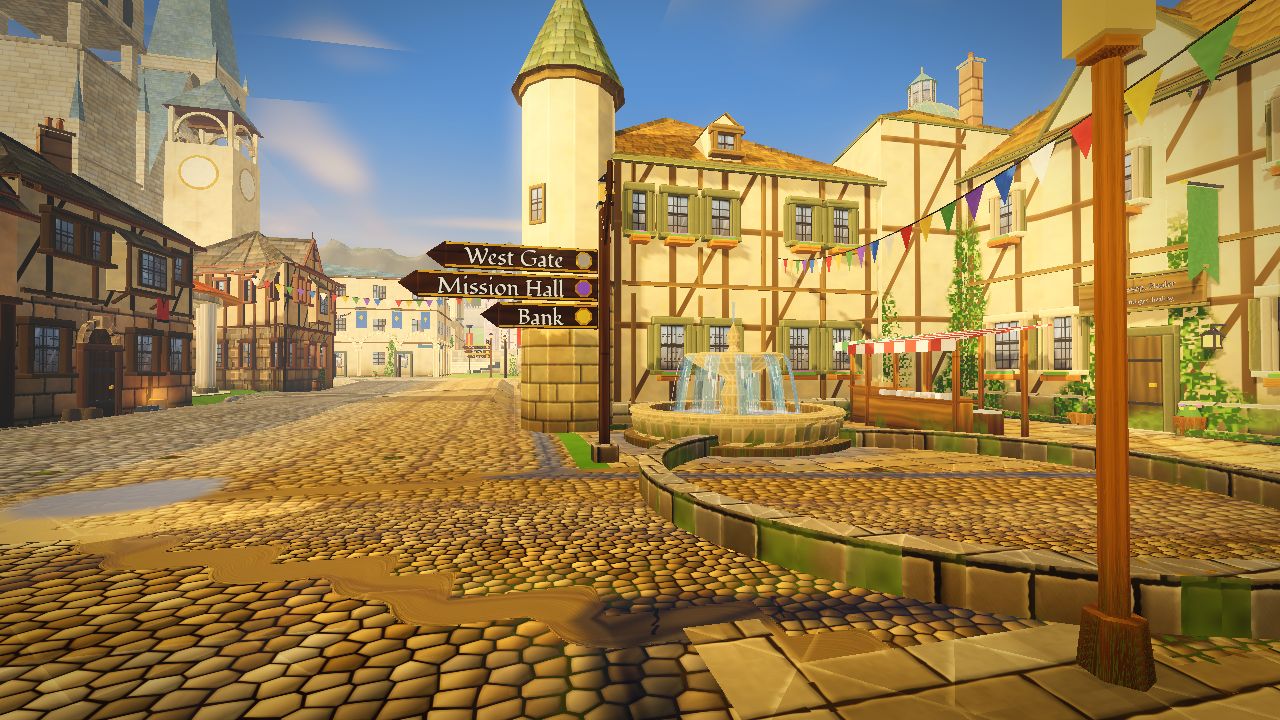
1.1 The idea in one paragraph
A painted, warm, lived-in medieval town: hand-painted surfaces that are "warm saturated but not neon" (docs/MASTERPLAN_CITY_BUILD.md:247-249), detail from paint rather than from geometry (docs/MASTERPLAN_ART_TECHNIQUES.md:22-25), nothing thin or flat (CITY_BUILD.md:240), and every visible thing closed: no gap, crack or open underside, while nothing a player can never see has a polygon at all (ART_TECHNIQUES.md:29-30). Colours are weathered toward lime plaster and old oak, because raw colours "read as fresh paint" (scripts/world/masterplan/mp_buildings.gd:618-620).
1.2 Palette
Base looks the whole city draws from (scripts/world/mats.gd:11-24):
| Material | Colour |
|---|---|
| stone | #a39c90 (dark #7f786e, castle #b8b0a0) |
| plaster | #ece1c6 (warm #ecd3a4) |
| timber | #5c3b22 (lighter wood #936238) |
| roof slate | #4d6d93 (red tile #a9463a) |
| window glass | #2f4660 |
Each quarter has its own palette (tools/city_map/geometry/city-masterplan.json:116096-116128), with roofs replaced in the art pass (mp_style.gd:46-53):
| Quarter | Roof | Wall | Timber | Trim | Ground-storey stone |
|---|---|---|---|---|---|
| central / civic | #3e5d8c slate | #efe3c8 | #4d3626 | #2f4f6f | #c9bfac |
| Mages' | #35539a blue-glazed | #e3dccd | #5a4a6e | #c9a548 gold | #d8d2c6 pale limestone |
| Warriors' | #4b5160 dark slate | #c9b79c | #4a3526 | #8c2f25 | #8c857b rough granite |
| Herbalists' | #7a5a32 thatch / mossy shingle | #e8dfc2 | #5c4a2a | #5f7f45 | #cdb07a honey stone |
(mp_style.gd:34-43 for the stone.) Most houses have that stone ground storey: civic 80%, Warriors' 90%, Mages' 85%, Herbalists' 55% (mp_style.gd:45). Trims are pale dressed stone #cfc4ae..#d8cdb5, beams oak #5c3b22, straps iron #4d5157 (scripts/world/masterplan/mp_materials.gd:40-44).
Weathering, so nothing looks freshly painted (mp_buildings.gd:622-628): walls at 0.5 x saturation and 0.96 x value, timber 0.8 / 0.95, trim 0.5 / 0.72, roofs 0.85 / 0.97, each house jittered a little in hue, saturation and value, and no two neighbours sharing a tint (mp_buildings.gd:660-680). Do the same in your textures: one base colour per material, then small per-object shifts.
1.3 Materials and textures
The city paints 13 seamless layers plus an 8-strip trim sheet at 256 px per metre, warm-balanced (1.06, 1, 0.88) because the first pass was "too cold and bleached" (mp_materials.gd:6-14; ART_TECHNIQUES.md:170-191). In a package:
- Textures are PNG or JPEG only, power-of-two sizes, JPEG for colour and PNG where you need alpha, alpha MASK for foliage (WORLD_FORMAT.md:52-54, 515-518).
- The browser caps a texture at 4096 px and all textures at 1 GiB counted as width x height x 4 (scripts/worlds/world_format.gd:16-24); a "sensible small world" keeps textures at 1024-2048 (WORLD_FORMAT.md:638-647). For the iamar look, 256 px/m on near surfaces is the city's density; a 2048 tiling texture covers 8 m.
- Paint the age in: darker, damper bases at the ground and under eaves, moss on north and stone faces, lighter wear along edges.
- No black and no pink (missing-texture) surfaces: that is a review check (WORLD_FORMAT.md:820-822; AGENT_KIT.md:150-155). Even "black" iron in the city is
#4d5157.
1.4 Shapes, scale and street sizes
Scale is checked in review: a person is 1.8 m, a door about 2.1-2.2 m (WORLD_FORMAT.md:820-822). The city's own numbers:
| Thing | Size | Source |
|---|---|---|
| Door leaf height | 2.28 m (grand doors: inn ~3 m, halls 4-5, library 6-7, cathedral ~8) | mp_buildings.gd:11; ART_TECHNIQUES.md:124-128 |
| Wall thickness | 0.18 m | mp_buildings.gd:12 |
| Storey | 3.2 m (ground storey up to 1.32 x, top down to 0.84 x) | mp_buildings.gd:691, 707 |
| Roof | 1/3 to 1/2 of the building's height; pitches 0.72-1.36 rise per run | CITY_BUILD.md:239-240; mp_buildings.gd:708 |
| Windows | 0.62-1.15 m wide, 0.36-0.5 of the storey tall, bays 1.9-3.1 m apart | mp_buildings.gd:882-886 |
| Eave overhang | 0.18-0.66 m | mp_style.gd:29-32; mp_buildings.gd:895 |
| Jetty (upper storey over the street) | 0.32-0.55 m | mp_buildings.gd:716, 892 |
| Oriel (bay window) | 1.6-2.4 m wide, 0.45-0.6 m deep | mp_buildings.gd:1053-1091 |
| Corner tower | radius 1.0-1.35 m, 12 sides | mp_style.gd:640-650 |
| Window box | at most 1.0 x 0.25 x 0.18 m | ART_TECHNIQUES.md:152-155 |
| Rooms | shops and homes ~5-6 m across, halls 10 m+ | ART_TECHNIQUES.md:158 |
Streets (the plan's paths[].width_m): lanes 5 m (the commonest), alleys 3 m, main streets 10 m, the King's Way 14 m, gate bridges 11-19 m.
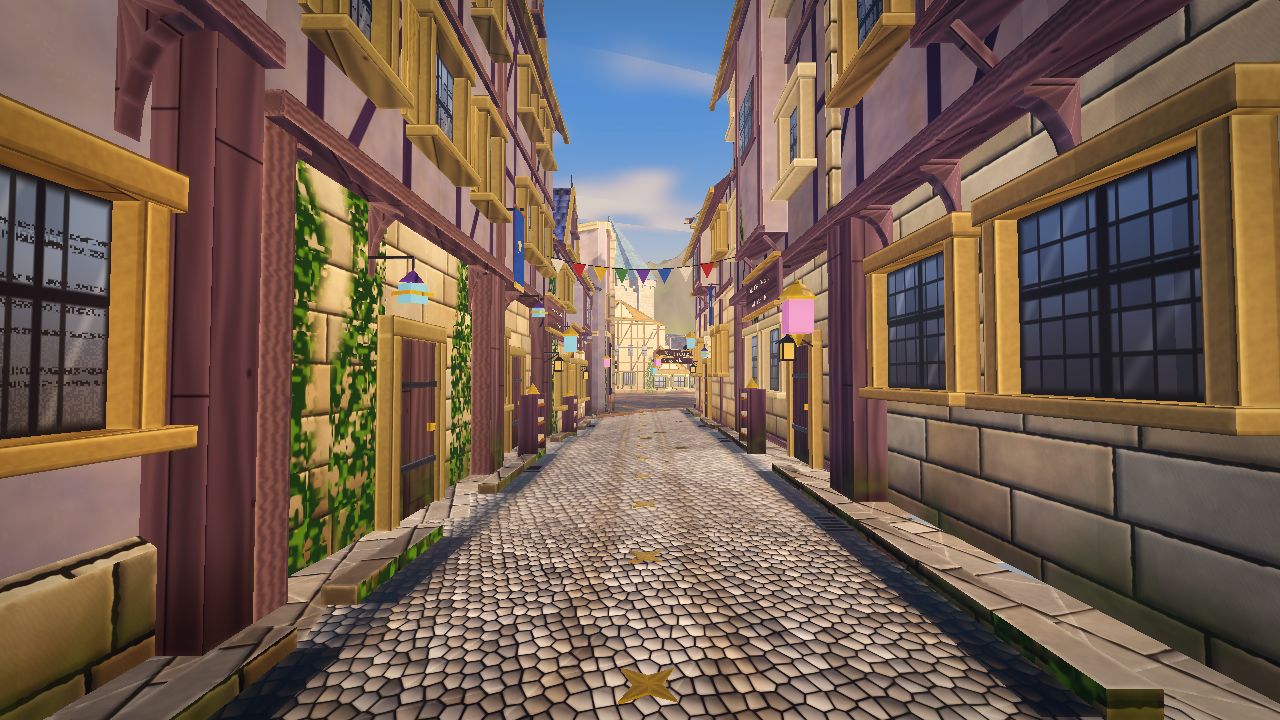
What makes a street front read at eye height, learned the hard way on the city (tests/masterplan_city/mesh_review.md, B7): in a 5 m lane the eave line is seen edge-on, so what reads is what stands out of the wall or above the eave: jetties, oriels, a gable or a dormer on every house front, corner towers, signs and window boxes. Eave height steps of under ~0.6 m are invisible from the street (mp_buildings.gd:714). Vary the houses: no two neighbours share a window rhythm, timber pattern, roof pitch or tint (tests/masterplan_city/mp_buildings_closure_test.gd:110-142).
1.5 Mesh budgets, closure and culling
| City | A package | |
|---|---|---|
| A house | ~1-3k triangles (median 2,198 over 121 houses) | same is a good target |
| A landmark | 5-15k | |
| A creature / mount | 3-8k / 6-12k | |
| The visible frame | "well under 1M primitives, shadows included" | low tier: under 150k triangles and 150 draw calls in the busiest view, 30 fps on a Radeon HD 5750-class card |
Sources: ART_TECHNIQUES.md:26-28; oakhaven-city-models models.json; kit/AGENT_KIT.md:233-243; docs/WORLD_TIERS.md:8-36. Browser hard limits: 3,000,000 triangles, 5,000 objects, 64 lights (world_format.gd:16-24).
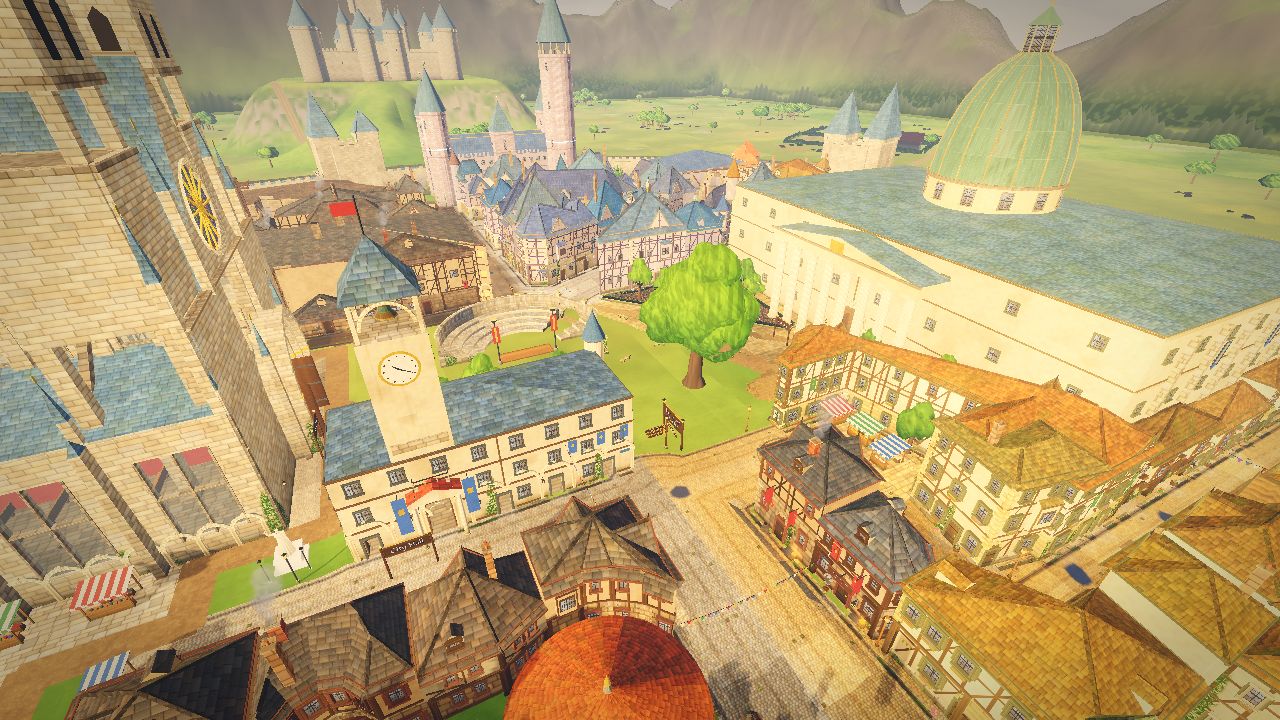
- Cull per face. Export only faces a player can see (oakhaven-city-models README:21). The city drops ~66-70k hidden faces of ~735k (ART_TECHNIQUES.md:70-79): undersides of things on the ground, faces against a wall, the backs of facades.
- Close what is seen. No open edges, gaps or cracks on anything visible; openings (doors, gates) stay open with a frame (ART_TECHNIQUES.md:29-33).
- No z-fighting. Two surfaces facing the same way must not share a plane: the city's audit flags anything within 2 cm (tests/masterplan_city/zfight_audit.gd:20-27). Offset by 1-2 cm or more along the normal, never by depth bias alone; glass 2.5 cm off its wall, panes 3 cm proud; a 5 mm gap still flickers (ART_TECHNIQUES.md:596-607). A window frame whose face lies 5 mm behind its glass is the classic mistake.
- LOD: the browser builds an LOD chain for every model by itself (1.0 / 0.5 / 0.2 at a 4 px threshold); you supply no LOD meshes (kit/recipes/TECHNIQUES.md:14-31). Give big far objects an
"impostor": <metres>(80-150 m suggested, default 120; TECHNIQUES.md:33-49) and small clutter avisible_range(WORLD_FORMAT.md:283). The city fades small meshes at 40-260 m by size and props at 110 m (mp_lod.gd:32-35; mp_budget.gd:51).
1.6 Light: what the city bakes, and what a package can do
The city bakes light in Blender Cycles (256 samples) into a lightmap on UV2: sky light (AO-like) and sun visibility, with a fixed sun 22 deg up (scripts/world/masterplan/mp_bake.gd:3-27; tools/bake_light.py:31-39, 79). Lamps at night add a warm pool on the ground, about twice the lamp's height across, toward 2700 K (mp_lamp_fx.gd:58; shaders/masterplan_look/lamp_pool.gdshader).
A package has no lightmap field. What it can do:
- Bake in Blender into vertex colours or a texture on UV2, and export the baked meshes with an Emission or Background material so the glTF carries
KHR_materials_unlit, which the browser honours. Bake only things that never move (kit/AGENT_KIT.md:334-369; kit/recipes/TECHNIQUES.md:169-187, "bake_sky_sun": texel 0.1 m, at most 4096). The city's own texel is 0.1 m (scripts/world/bake.gd:27-28). - Or stay live-lit with one sun:
scene.environment.sun(colour, energy, direction, shadows),ambient,sky,fog,exposure,time_of_day(WORLD_FORMAT.md:164-206). The browser renders one sun shadow pass over 50 m with a linear tonemap (scripts/worlds/world_builder.gd:274-314); theshadowstier switch can turn it off. - Point and spot lights: only the nearest 6 lamps get a real light (TECHNIQUES.md:149-165), shadows default off. Fake the rest with emissive windows and lantern glass.
- Not available to a package: weather (accepted and ignored, WORLD_FORMAT.md:207-209), a moving day (
day_length_minutesis in the schema but nothing reads it yet), and script control of light, time or weather (no such call in docs/WORLD_API.md).
1.7 Atmosphere
The city's default "golden" look (scripts/world/masterplan/mp_look.gd:39-48): sky #3f78d0 to horizon #f8e6cc, sun #ffc274, ambient #b4aaa6, a cool fog #ccd8ea at density 0.0013 that thins with height (x1 at 8 m, x0.15 at 60 m), filmic tone mapping, a light vignette (0.28). Night (lines 75-84): sky #0b1434, a silver moon #c4d2f4 at 0.6, slate ambient #66708e, fog #1c2646. Each quarter tints its fog and lamps: Mages' violet #8a78e8 / #9c8cff, Warriors' ember #d08050 / #ff9a48, Herbalists' meadow #e6e2a2 / #ffd28c (lines 92-100).
A warning from the city: a warm, peachy fog (#eccfa8, heavy sun scatter) tinted the whole valley yellow from the air; the fix was the cool #ccd8ea with less scatter (docs/MASTERPLAN_TODO.md, B15). Keep the warmth in the sun and the surfaces, and the fog cool and light.
In a package, set these through scene.environment (sky, sun, ambient, fog, exposure, time_of_day) rather than per-object effects (TECHNIQUES.md:262-274). The browser applies a linear tonemap, so you will want slightly less sun energy and a touch more ambient than the city's filmic values.
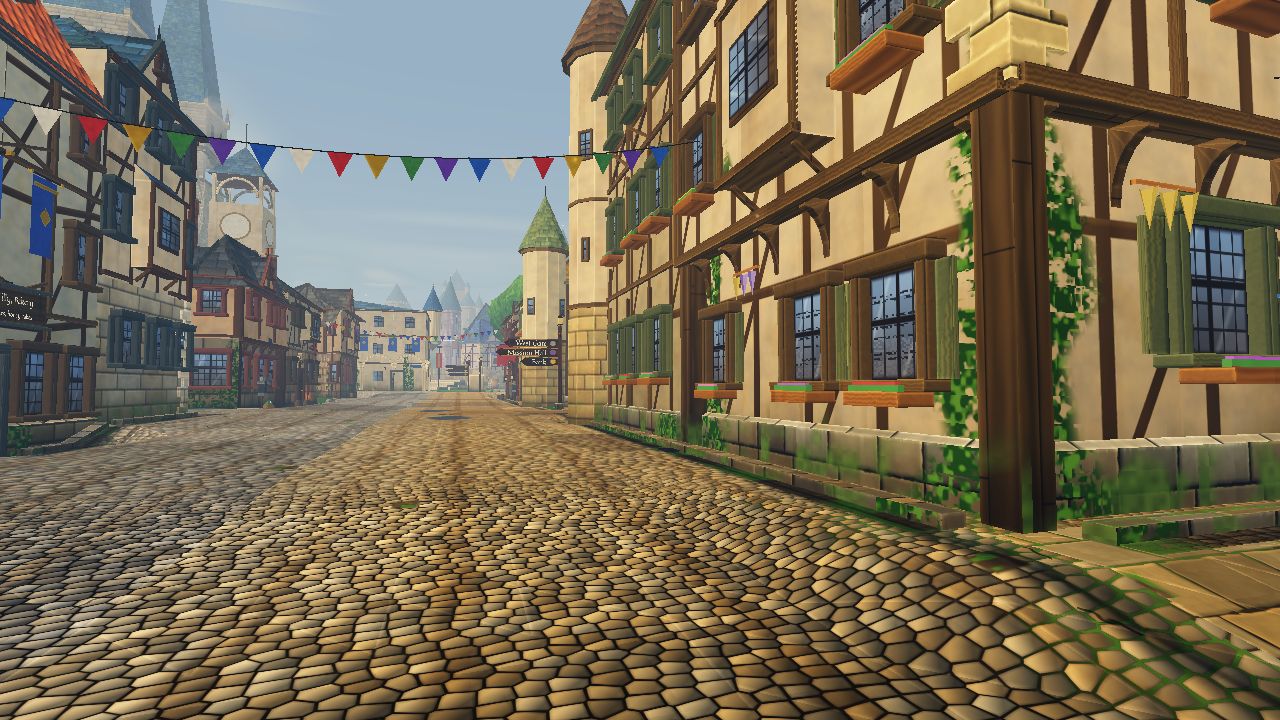
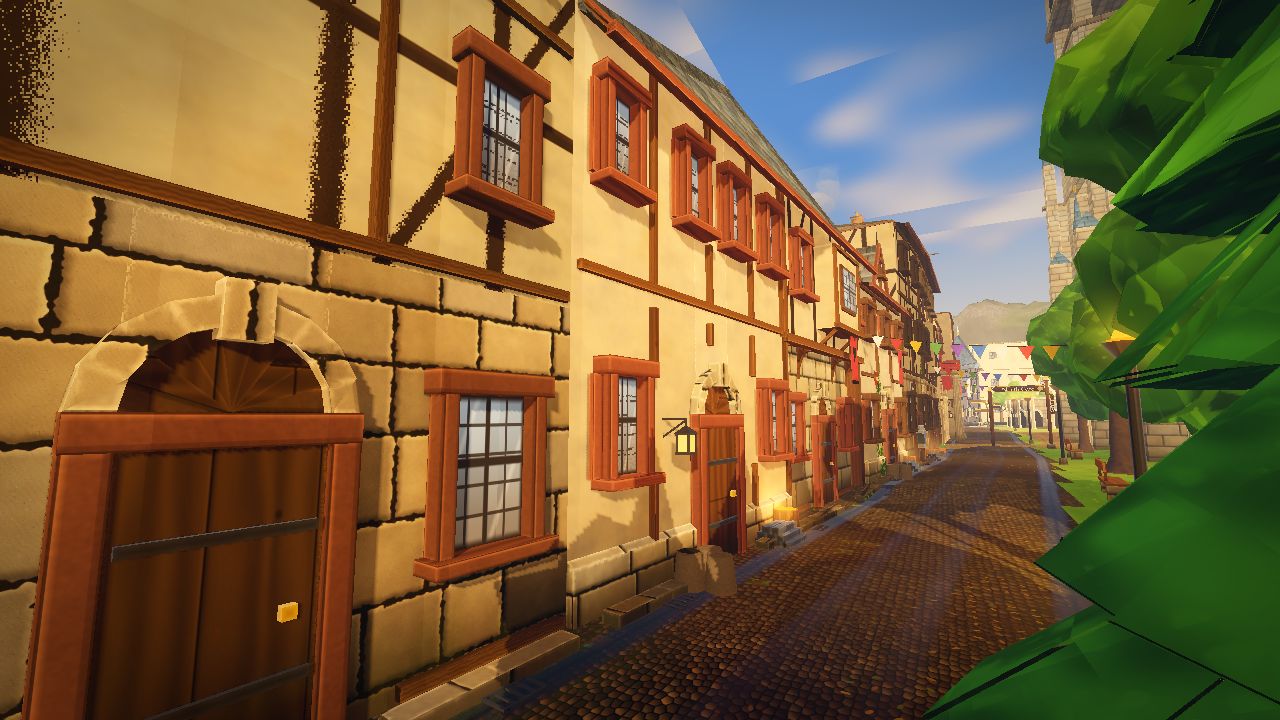
The same street by day (10:00) and at night (21:30)
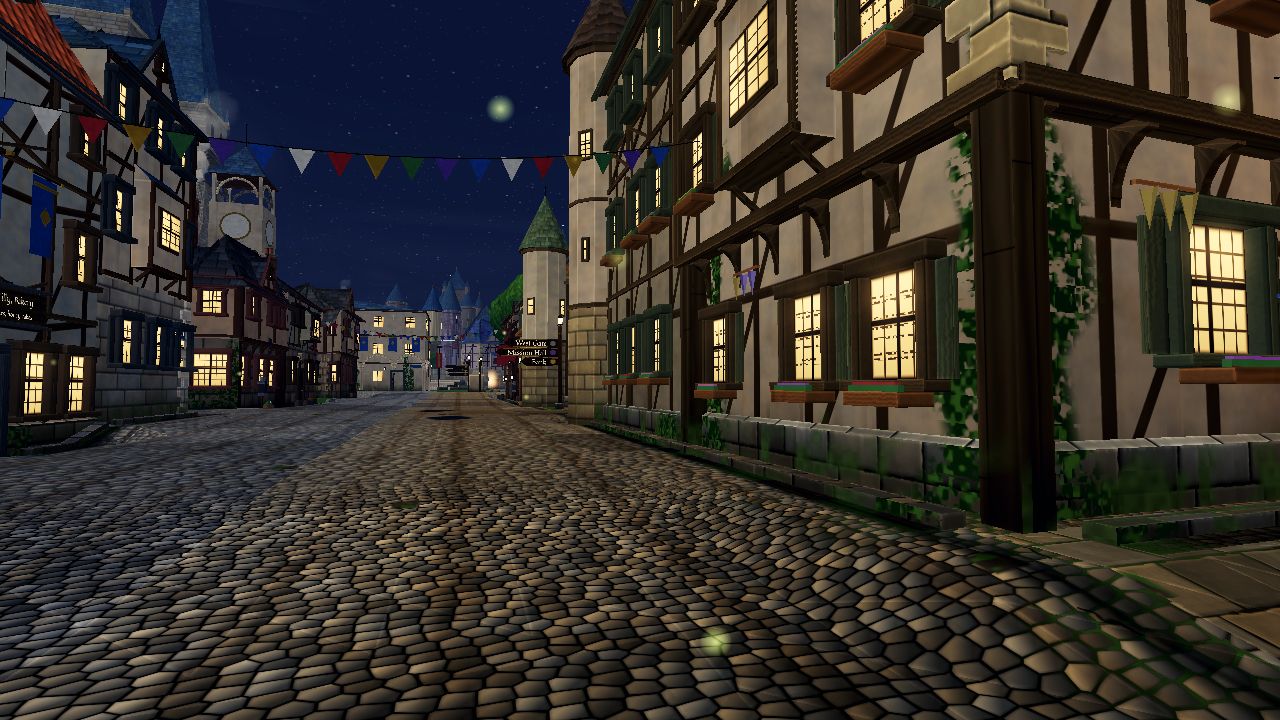
At night: warm lit windows (each quarter its own glow colour, mp_look.gd:118-119), a silver moon, the street still readable
1.8 Ground and flora
- Paving: setts 15-21 cm (0.17 x 0.12 m typical), larger flags in the squares (courses ~0.52 m, lengths ~0.92 m), with 2.6 cm joints (shaders/mp_ground_paving.gdshaderinc:45-130). Paint wear and ruts down the middle of a street, damp along the walls.
- Grass and flowers are alpha cards, faded out with distance: tufts 0.9 x 0.7 m to 26-40 m, flowers 0.8 x 0.75 to 34-52 m, reeds 1.3 x 1.9 to 60-90 m (mp_flora.gd:18-25), sampled about every 1.1 m.
- Beds and gardens: each bed its own plants, never uniform rows of one plant (the city's herb and kitchen gardens: mp_herb_garden.gd, mp_crop_beds.gd). Plant spacing 0.2-0.95 m by crop.
- Trees switch to impostor cards at 45-75 m (scripts/world/forest_impostors.gd:23-25).
2. Raising the art quality, step by step
Work in this order; each step is worth more than the next.
- Scale. Put a 1.8 m person and a 2.2 m door in every view you check. Wrong scale undoes everything after it.
- Silhouette. Roofs a third to a half of each building; overhangs, jetties, gables and chimneys break every roofline; no long same-height flat front.
- Palette and paint. One weathered base colour per material from 1.2, a small shift per object, texture density near 256 px/m on what the player walks past. No pure black, no fresh-paint colours.
- Closure and culling. Close every visible edge, delete every face nobody can see, offset every overlay by 2 cm or more.
- Light. Bake sky and sun light into the static meshes (1.6), or tune one live sun with a soft ambient; lit windows and lantern glass at night.
- Atmosphere. A cool, light fog that hides the far edge of the world, a sky that matches the sun, the time of day you want.
- Dressing. Signs, window boxes, barrels, carts, banners, plants; vary them, never in rows.
- Budget. Measure the busiest view against the low-tier targets in 1.5; add impostors and
visible_rangebefore cutting detail near the player.
Self-check list (run it on your own screenshots)
Take eye-height (1.7 m) screenshots in the busiest street, the widest square and one alley, by day and at night, and one from above. Then check:
- A person-sized reference fits doors and stairs (door ~2.1-2.3 m).
- No black or pink surface anywhere; nothing looks freshly painted.
- Every roof has an overhang and every roofline is broken somewhere.
- No two neighbouring buildings share colour, window rhythm and roof pitch.
- From the street, something projects from or rises above every house front.
- No flicker when you walk past walls, windows, signs and the ground (z-fighting).
- No gaps, holes or open undersides from any reachable view, including from above.
- Nothing floats above or sinks into the ground.
- Flora and beds are mixed, not uniform rows.
- The fog is cool and light; the sky is not tinted yellow from above.
- Night: windows and lanterns glow warm; the scene is readable, not black.
- Low tier: the busiest view is under 150k triangles and 150 draw calls and holds 30 fps (kit/AGENT_KIT.md:233-243), and it still looks "pleasant, not just functional" (WORLD_TIERS.md:161-162).
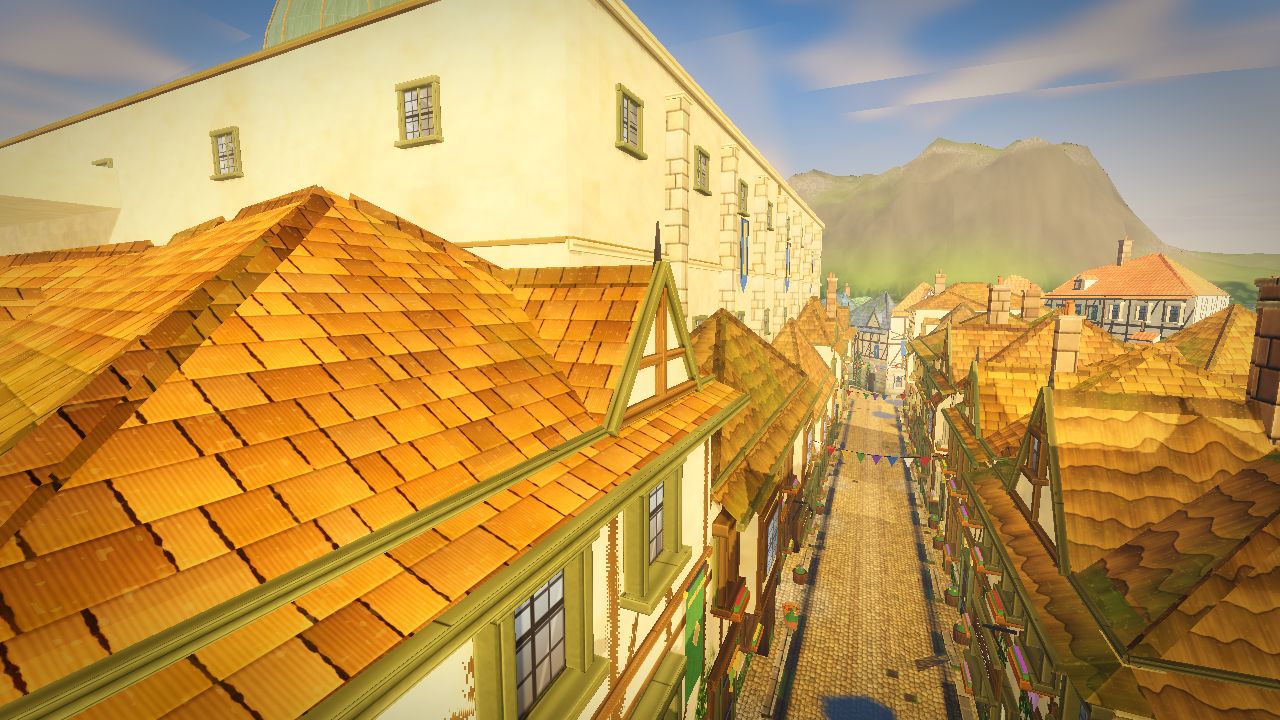
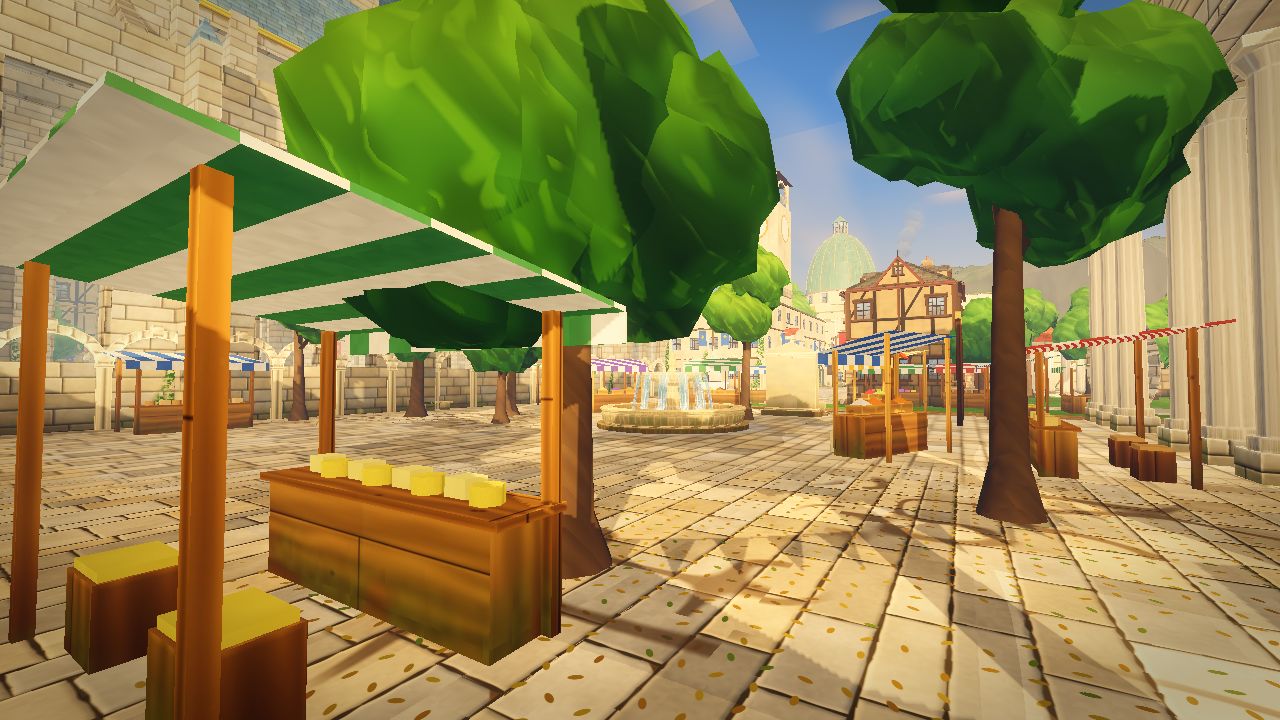
Images: rendered from the iamar city (main, 2026-10-10) at 1280x720 on emma, without its baked lighting (tests/masterplan_city/mp_materials_shots.gd). Written by Z-EMMA for the iamar.ai world-creator docs (board #2540).
Rendered from docs/WORLD_ART_GUIDE.md in endsley/iamar (1a54596596, 2026-10-10). Regenerate with python3 site/sync_docs.py — never edit this page by hand.